Most homeowners face this exact moment: an appliance stops working and you have no idea whether to call for help right now or wait until next week. Understanding how appliance repair urgent vs routine works is the difference between a $150 scheduled visit and a $500 after-hours emergency call. These two service types operate under completely different rules for scheduling, pricing, and technician dispatch. This guide breaks down exactly how each works, what drives the cost gap, and how to make the right call every time.
Table of Contents
- Key takeaways
- How appliance repair urgent vs routine works
- How service providers triage and dispatch repairs
- Cost of emergency repair vs scheduled service
- Repair timelines: what to expect from call to completion
- How to decide: is your repair urgent or routine?
- My honest take on avoiding appliance emergencies
- Get same-day appliance repair from Pfc-mt
- FAQ
Key takeaways
| Point | Details |
|---|---|
| Urgency is about safety and damage risk | If an appliance poses a safety hazard or is actively worsening, it qualifies as an emergency repair. |
| Emergency repairs cost significantly more | Urgent service can run 50–100% more than a scheduled appointment due to dispatch fees and after-hours rates. |
| Routine repairs can wait without consequence | Low-risk issues with no spreading damage can be scheduled within 24 to 48 hours or longer. |
| Symptom detail speeds up service | Giving dispatchers your appliance model and specific symptoms increases your chances of a same-day fix. |
| Proactive maintenance prevents emergencies | Scheduling regular tune-ups reduces the likelihood of facing a costly urgent repair call. |
How appliance repair urgent vs routine works
In the appliance repair industry, the standard terms are emergency maintenance and routine maintenance. These two categories differ in one fundamental way: the level of risk involved if you wait.
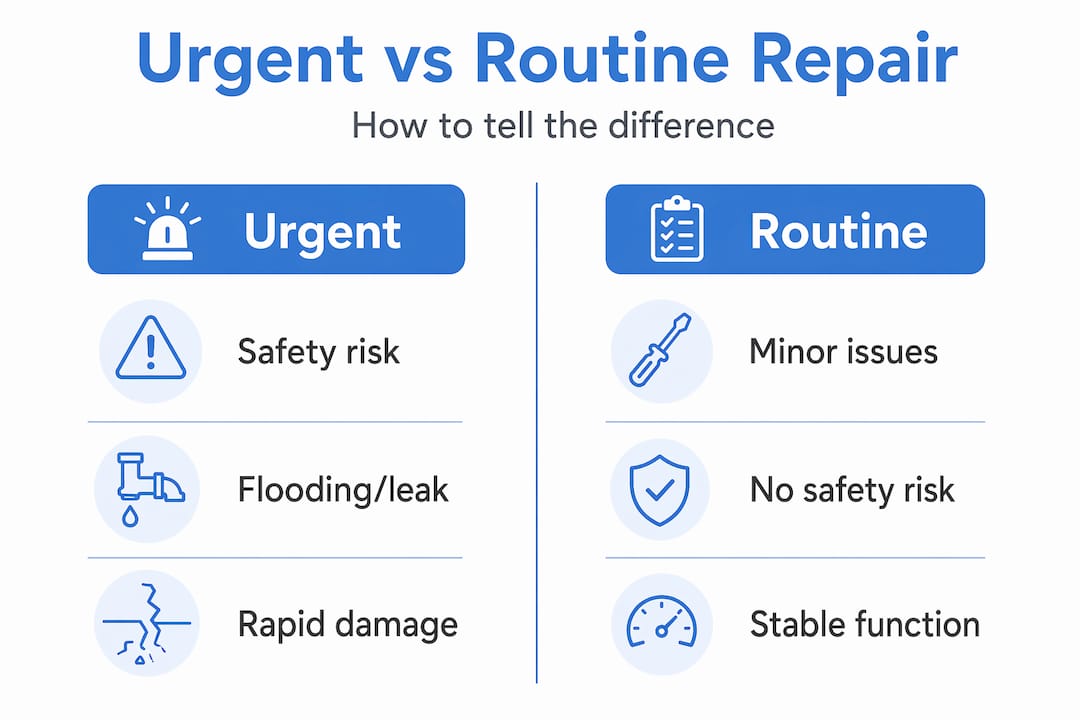
Emergency maintenance requires immediate action because of high safety risk or the threat of rapidly worsening damage. Routine maintenance, by contrast, covers low to moderate urgency issues where waiting a day or two creates no meaningful harm.
Here is how the two types compare side by side:
| Category | Emergency repair | Routine repair |
|---|---|---|
| Response time | Same-day, often within hours | 24 to 48 hours or by appointment |
| Safety risk | High (gas, flooding, electrical) | Low to none |
| Damage progression | Actively worsening | Stable or slow-moving |
| Cost level | 50 to 100% above standard rates | Standard service rates |
| Examples | Gas leak, refrigerator failure with food loss, no heat in winter | Noisy dryer, slow dishwasher drain, minor ice maker issue |
Professionals use a risk-based decision framework to classify every incoming repair request. The two core questions are: does this create a safety hazard, and is the damage spreading? If the answer to either is yes, the repair is classified as urgent.
Common emergency scenarios include:
- A gas range leaking fuel
- A washing machine flooding the floor
- A refrigerator failing during a heat wave with hundreds of dollars of food at risk
- A furnace or heat pump going out in freezing temperatures
Routine repair scenarios look very different. A dryer that takes two cycles to dry clothes, a dishwasher leaving residue on dishes, or a refrigerator ice maker producing small cubes. Annoying? Yes. Dangerous or worsening rapidly? No.
How service providers triage and dispatch repairs
When you call for appliance repair, your request enters a queue. What happens next depends entirely on how your issue is classified. Companies triage jobs by urgency and safety risk, sending urgent calls to the front of the line while routine visits get slotted into the next available window.
This process gets more complicated during peak seasons. Summer air conditioning failures and winter heating breakdowns flood repair companies with calls simultaneously. Routine maintenance backlogs grow fast during these periods, which is exactly why scheduling non-urgent work before peak season pays off.
Technician availability and parts inventory also shape how quickly you get served. Repair companies often prioritize urgent calls with clear diagnoses and available parts because they can achieve a first-visit fix, which is more efficient for everyone. An ambiguous problem description, or a repair that likely requires a specialty part, may get deprioritized even among urgent calls.
Dispatchers use triage questions to assess symptoms before sending a technician. They want to know the appliance brand and model, the exact symptom, when it started, and whether anything has changed recently. This intake process determines which technician goes out, what tools they bring, and whether they need to pre-order parts.
Pro Tip: Before you call, write down your appliance brand, model number, the specific symptom, and when it started. Dispatchers who get this information upfront can match you with the right technician faster and dramatically improve your odds of a same-day resolution.
The practical takeaway here is that being a well-prepared caller gives you a real advantage. Vague descriptions like "my fridge is acting weird" create friction in the dispatch process. Specific descriptions like "my LG French door refrigerator is running constantly but not cooling below 50 degrees" get you triaged faster and matched with a technician who already knows what to check.
Cost of emergency repair vs scheduled service
This is where the difference between urgent and routine repair hits hardest. Emergency repairs are priced to reflect the real cost of rapid dispatch, after-hours labor, and 24/7 availability. That cost gets passed directly to you.
Here is what the numbers typically look like:
- Dispatch or service call fee: Urgent calls often carry fees between $100 and $250 just to get a technician to your door.
- After-hours labor rates: Standard hourly labor runs $75 to $150 per hour. After-hours rates climb to $200 to $400 per hour, covering the premium for nights, weekends, and holidays.
- Total repair cost for a one-hour fix: When you add dispatch fees and after-hours labor, a repair that would cost $150 during business hours can easily reach $400 to $600 as an emergency call.
Calling an emergency service when the situation does not actually require it can result in 50 to 100% higher costs. Correctly timing your repair call is one of the simplest ways to control home maintenance expenses without taking on unnecessary risk.
After-hours premiums exist because 24/7 service requires companies to staff technicians around the clock, maintain on-call schedules, and keep vehicles stocked with common parts at all times. That infrastructure is expensive, and emergency pricing reflects it.
The smartest cost control strategy is temporary mitigation. If your refrigerator is struggling but not completely dead, moving perishables to a cooler buys you time to schedule a next-morning appointment instead of a midnight emergency call. If a washing machine is leaking slightly, shutting off the water supply and waiting until morning turns an emergency into a routine call. Not every situation allows this, but when it does, the savings are real.
Always ask upfront for the full cost breakdown: the dispatch fee, the hourly rate, and whether the dispatch fee gets credited toward the total repair bill. Transparent providers will give you this information before sending anyone out.
Repair timelines: what to expect from call to completion
How long a repair actually takes depends on two separate factors: the onsite work itself and parts availability.
Most appliance repair visits take one to three hours on site. A technician diagnoses the problem, confirms the fix, and completes the repair in that window if the necessary parts are on the truck. For urgent repairs where the issue is common and the part is stocked, same-day completion is realistic.
The variable that stretches timelines is parts. Here is a practical breakdown:
| Scenario | Typical total timeline |
|---|---|
| Common appliance, stocked part | Same-day to 24 hours |
| Common appliance, ordered part | 2 to 5 business days |
| Older or less common appliance | 1 to 2 weeks or longer |
| Specialty or discontinued part | 2 to 4 weeks or unknown |
Older appliances and less common brands consistently face longer wait times because parts are not kept in standard inventory. If you own a 15-year-old appliance from a brand that has limited distribution, factor in extra time for any repair regardless of urgency level.

For urgent repairs, the best outcome happens when your problem is common, your appliance model is widely serviced, and you call early in the day. Calling at 7 a.m. with a clear symptom description gives a repair company the best chance of getting you on the same-day schedule with the right parts already loaded.
How to decide: is your repair urgent or routine?
The decision framework professionals use comes down to three questions. You can apply the same logic at home.
Ask yourself these questions before calling:
- Is there a safety hazard right now? Gas smell, electrical sparks, flooding, or fire risk all mean call immediately.
- Is the damage actively spreading? A slow leak becoming a fast leak, or a cooling problem causing food to spoil, signals urgency.
- Does this affect habitability? No heat in January or no refrigeration during a heat wave crosses into emergency territory.
- Can I safely mitigate the problem temporarily? If yes, you may be able to convert an urgent situation into a routine one.
If you answer yes to the first two questions, safety risk and worsening damage are the criteria that define an emergency. Call for urgent service.
If you answer no to both, schedule a routine appointment. You will pay standard rates, get a scheduled window, and the repair will get done without the emergency premium.
Pro Tip: Document your symptoms before calling. Take a short video of the appliance behavior, note any error codes on the display, and record when the problem started. This documentation helps dispatchers triage your call accurately and gives the technician a head start on diagnosis.
Delaying routine maintenance is one of the most reliable ways to create an emergency down the road. A dryer vent that has not been cleaned in two years does not just reduce efficiency. It becomes a fire hazard. A refrigerator with a worn door seal that goes unaddressed for six months eventually strains the compressor to the point of failure. Routine care prevents the kind of breakdowns that force your hand on emergency calls.
My honest take on avoiding appliance emergencies
I have seen the same pattern repeat itself more times than I can count. A homeowner ignores a small, obvious symptom for months because it does not seem urgent enough to deal with. Then the appliance fails completely at the worst possible time, usually a holiday weekend or the hottest day of summer, and they end up paying emergency rates for a repair that could have been a simple scheduled visit.
The truth is that most appliance emergencies are not random. They are the end result of postponed routine care. That noisy washing machine bearing does not just stay noisy. It progresses. That refrigerator that runs a little warm eventually stops cooling altogether.
What I have learned is that the best time to schedule routine maintenance is before you need it. Get your major appliances looked at before peak seasons. Book a check before summer if you rely heavily on refrigeration. Schedule a furnace or heat pump inspection in early fall before every repair company in town is slammed with emergency calls.
I have also seen how much a precise symptom description matters on urgent calls. Homeowners who call with clear, specific information get faster service. It is not favoritism. It is logistics. A technician who knows exactly what they are walking into can bring the right parts and resolve the issue in one visit.
Do not overuse emergency calls for problems that can wait. But do not underestimate a real risk either. The framework in this article gives you the criteria to tell the difference.
— Timofei
Get same-day appliance repair from Pfc-mt
When you need help fast, or want to get ahead of a problem before it becomes one, Pfc-mt is ready to help.
Pfc-mt's same-day service connects you with skilled technicians who arrive prepared, diagnose accurately, and give you transparent pricing before any work begins. Whether you are dealing with a refrigerator that stopped cooling overnight or a dryer that has been running slow for weeks, the team handles both urgent and routine repairs with the same level of care. Scheduling routine maintenance through Pfc-mt is one of the most practical ways to avoid the emergency call you never wanted to make. Book your appointment today and stop guessing.
FAQ
What counts as an urgent appliance repair?
An urgent repair involves a safety hazard, active flooding, gas leaks, or damage that is actively worsening. If waiting even a few hours increases risk to people or property, the repair is an emergency.
How much more does emergency appliance repair cost?
Emergency repairs typically cost 50 to 100% more than scheduled service due to dispatch fees and after-hours labor rates. A one-hour fix that costs $150 during business hours can reach $400 to $600 as an emergency call.
How long does an urgent appliance repair take?
Most onsite repair visits take one to three hours. If the technician has the necessary part on the truck, same-day completion is realistic. Specialty or backordered parts can extend the total timeline to several days or longer.
Can I reduce the cost of an emergency repair?
Yes. Temporary mitigation, such as moving food to a cooler or shutting off a water supply valve, can sometimes convert an emergency into a next-morning routine call. Always ask the provider upfront about dispatch fees and whether they are credited toward the total bill.
How do I know if my repair can wait?
Apply three questions: Is there a safety hazard? Is the damage spreading? Does it affect habitability? If the answer to all three is no, routine maintenance scheduling within 24 to 48 hours is appropriate.